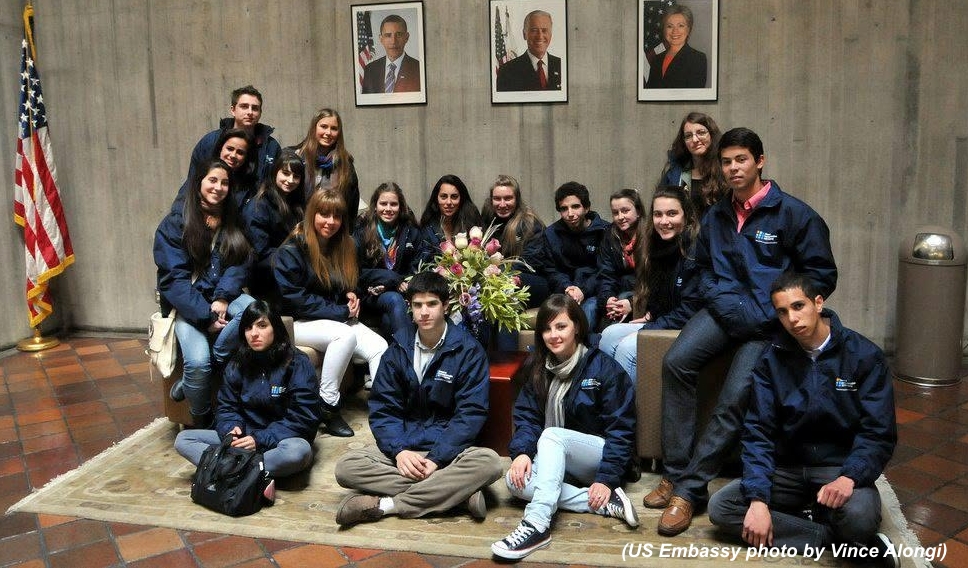
Returning from one of many trips to the interior as part of an
ambassadorial visit—this time from Artigas—with several
hours ahead of us and with the experience of having previously been
in contact with young people from all over the country, one of the
most successful programs carried out by the embassy was born.
Along with Vince Alongi, who at the time was responsible for the
embassy’s social media and was my road companion for ten
years, we had noticed a great need for new opportunities.
At the end of each long workday, we had the custom of having a
whisky and smoking a cigar while reviewing what the following day
would bring. And always, on a recurring basis, the topic of "doing
something" for the youth of the interior would come up.
Thus, as we were devouring the kilometers on the return trip to
Montevideo, "Youth Correspondents" was born—a
program that sought to give young people the opportunity to be
journalists.
As soon as we returned to the office—that is, the day after
getting back—the first thing we did was pitch the idea to our
boss, Susan Bridenstine, who became just as enthusiastic as we were.
Such was the eagerness and interest sparked by the project that no
one in the office stopped participating, collaborating, or pitching
ideas. In addition to Vince, everyone pitched in wherever necessary:
Silvana Patrone, Pablo Castro, Blanquita Gari, Marcelo Serra,
Mauricio Puente, Adela Durán, Lucía Arbelbide, and
Verónica Pérez Urioste.
The first problem that arose was funding, since our budget did
not have the necessary funds for an "off-program" program,
if you'll pardon the redundancy. But luck was on our side. Around that time, Secretary of State Hillary Clinton
had created a special fund to finance original projects that met a
series of pre-established goals and objectives.
That is where our initiative went. And destiny would have it that
not only was it approved and taken as an example for other
countries, but we were granted five times the money we requested.
Youth Correspondents was now a reality.
The program was implemented in mid-2011 and called upon all young
people from the interior between 15 and 18 years old whose vocation
was in journalism. The requirement to participate was having no
prior experience.
Each of the young and vocational correspondents provided their
materials from their home departments, reporting on the various news
events happening in their towns, thereby bringing the realities of
the interior closer to the capital. In this way, 18 budding
journalists spent a year doing journalistic coverage, writing on
their own blogs, and participating in various profession-related
activities, such as workshops and seminars taught by professionals
from prominent media outlets who shared their experience in the
field. Four were rewarded with a work trip to the United States,
visiting the cities of Washington D.C. and Miami.
The 18 youths had the opportunity to attend seminars given by
United States government representatives, as well as to interview
and exchange views with prominent Uruguayan politicians, who shared
their general experience and spoke specifically about the
relationship between the work they performed and the press.
They are referred to as "the 18..." because Montevideo
was specifically excluded. The program had set out with the
objective of giving a voice to residents of the interior, who are
often ignored by the capital.
Even today I remember a dialogue that took place in the city of
Salto. We were presenting the program to a group of young people at
the headquarters of the Uruguay-United States Cultural Alliance,
trying to get them excited to participate, when one of the attendees
interrupted me. "All very nice, but the same thing always
happens: the ones who end up winning are from Montevideo," he told me. Great was his surprise, and
that of the other attendees, when I clarified that Montevideo was
not part of the program, as it was exclusively intended for the
interior of the country. "There are going to be 18 selected
participants representing each of the departments," I
explained.
Immediately, questions about the details of the program began. In
fact, Salto was one of the departments with the highest number of
participants, and its representative (a young lady) was one of the
four final winners.
Following the proposal, from every corner of the country a group
of teenagers dressed up as journalists to publish written articles,
videos, and photographs.
Canarios Informados; Artigas News; Eyes on
Colonia; Cerro Largo Noticia Joven; Maldonado Online;
Paysandú Breaking News; Rivera Informa; and
Mirada Salteña were some of the 18 blogs created by
the participants featuring news from the interior of Uruguay, which
they were required to keep updated.
Each participant was given a netbook and a digital camcorder to
work with. We never gave them a break. They had their own initiative
to publish topics of interest to them, but not a day went by without
us in Montevideo asking them for reports on specific events in each
of their departments. They always had homework to do.
The future journalists not only received all the necessary
equipment to carry out their work, but they also participated in
four seminars featuring journalists, politicians, and other members
of society. Two of those seminars were held in Montevideo and the
other two in Colonia and Maldonado. There was also no shortage of
visits to print media outlets, radio stations, and television
channels, where they had the opportunity to interact with their
future colleagues.
The first seminar in Montevideo lasted two days and began with an
official lunch at the embassy itself, styled like a corporate
luncheon, with the keynote speaker being the late former president
of Texaco, Minister of Industry and Energy, and ambassador to
France, Jorge Lepra. As soon as the lunch ended, the first day of work at the Hotel Ibis began, where for a day and a half they
received lectures and talks from the most recognized journalists and
correspondents accredited in Uruguay.
At the end of each event, it was our custom—in addition to
evaluating the program—to ask the young people about their
concerns and requests for the next meeting.
Thus, we dedicated the following seminar to radio. A single phone
call to Washington was enough for Iscar Blanco, director of Voice of
America for the region, to drop everything and catch the first
flight to Montevideo. Iscar, a Colombian married to a Uruguayan
woman and with a great sense of humor, tortured the
youngsters during two days of sessions at the Hotel Nirvana in Nueva
Helvecia, where he barely left them a few hours to rest. Such was
the enthusiasm generated by the program that even actor Diego
Delgrossi gladly agreed to travel to Nueva Helvecia to share some
humor after dinner with the tired correspondents.
The following seminar had a distinctly political profile. The
young people had the opportunity to meet former presidents Julio
María Sanguinetti and Luis Alberto Lacalle, and the then-vice
president of the Republic, Danilo Astori.
Sanguinetti, a thoroughbred journalist, delivered a masterclass
for two hours without a pin dropping. The next day, Lacalle—then
a senator—hosted them for an entire morning at the Legislative
Palace, even stepping away from a Senate session. Not a pin dropped
there either. In the afternoon, the doors of the vice president's
office opened for these youths from the interior, who had an
exchange with Astori on current affairs and asked him more than one
tough question, as if they were seasoned journalists.
We reached the final seminar and, as usual, we asked them the
mandatory question about upcoming speakers. "Tabaré
Vázquez and coach Tabárez" were the unanimous
requests of the young people. And off we went to fulfill their wish.
But neither of the two agreed to participate in the program. An
advisor to the current president told us it was practically
impossible and that we should look toward Astori's side.
We contacted coach Tabárez through friends working at
Tenfield. I had a telephone conversation in which I explained that
it was a group of young people traveling together for a one-time
trip from various points in the interior, but he declined the
invitation. There was no way to convince him.
"Not even five minutes to take a picture with us?", was
the question from the youngsters when we told them that this time we
had failed in their request. "Not even five minutes," was
our response. "Journalists don't always achieve their goals,"
I added.
At the tender age of 15, 16, 17, and 18, these adolescents made
their voices heard—the voice of the interior of Uruguay. Many
of them have since embraced this profession and work with great
success in various media outlets in the interior and in Montevideo.